

In 2025, the FHLBanks collectively had $7.8 billion in CIP advances outstanding for housing and issued $2.5 billion in CICA funding for economic development.
CIP funding is intended to support housing for households earning up to 115 percent of area median income, as well as commercial and economic development activities that benefit low- and moderate-income families or are located in low- and moderate-income neighborhoods. CIP financing instruments include advances and letters of credit, with the vast majority of funding delivered through advances. CIP advances provide slightly lower rates than general FHLBank advances and are priced at cost of funds plus reasonable administrative expenses.
In 2025, roughly $7.8 billion in CIP advances were outstanding across the FHLBank System for housing and economic development projects for specific populations such as underserved communities, seniors, and low- to moderate-income households.
Between 2015 and 2024, CIP advances provided $48.8 billion in funding, according to research by the Urban Institute. More than 95% of this funding supported housing projects and advances accounted for 87% of CIP funding during this period.
Community Investment Cash Advance Program
CICA funding is directed to specific eligible uses, including financing for small businesses and projects in designated geographic areas. CICA financing instruments include advances, letters of credit, and grants, with the vast majority of funding delivered through advances. The program is optional and available to both FHLBank members and housing associates. CICA advances provide slightly lower rates than general FHLBank advances.
Eligibility varies by location. In urban areas, CICA funding is available for targeted beneficiaries with incomes at or below 100 percent of area median income, while in rural areas the threshold is 115 percent of area median income.

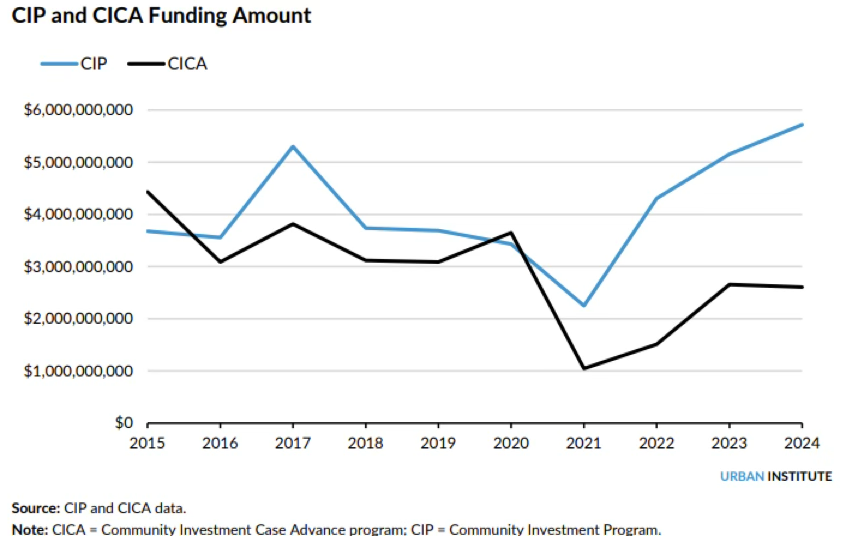
In 2025, the FHLBanks issued approximately $2.5 billion in CICA advances, supporting economic development projects that strengthen lower-income communities and small businesses. These investments helped businesses create and preserve more than 25,000 jobs.
Between 2015 and 2024, CICA provided $29 billion in lending, according to research by the Urban Institute. Advances accounted for 96 percent of CICA funding during this period.